
Does Your Neighbor's Recent Sale Impact Your Home Value?

If you've noticed a "Sold" sign come down in your neighborhood, you've probably wondered, "What did that home sell for?" Closely followed by, "Does that affect what my home is worth?"
It's one of the most common questions I hear from homeowners, and the short answer is yes, it can affect your home's value. But it's rarely as simple as one house selling down the street.
A recent neighborhood sale is an important piece of the puzzle, but it's only one of many factors buyers, real estate agents, and appraisers consider when determining what your home is worth. Understanding how those sales are evaluated can help you make smarter decisions, whether you're planning to sell soon or simply want to know how much equity you've built.
Yes, Your Neighbor's Sale Can Affect Your Home's Value
When a home sells in your neighborhood, it becomes one of the data points used to estimate the value of nearby homes.
The closer that property is to yours in terms of location, size, age, layout, condition, and features, the more influence it may have.
For example, if your neighbor's home has:
A similar floor plan
The same number of bedrooms and bathrooms
Comparable square footage
A similar lot size
Similar updates and overall condition
It can serve as an excellent comparison.
However, if that home has a fully renovated kitchen, updated bathrooms, a finished basement, an addition, or extensive landscaping that your home doesn't have, those differences need to be accounted for before anyone can accurately estimate your home's value.
One Sale Doesn't Define the Market
One of the biggest misconceptions I hear is:
"My neighbor sold for $900,000, so my house must be worth $900,000 too."
It doesn't quite work that way.
Every home has strengths and weaknesses that influence what buyers are willing to pay. Even homes on the same street can have meaningful differences that impact value.
I also remind homeowners that one sale never tells the whole story.
When evaluating a home's value, I look at:
Several recent comparable sales
Current homes competing for buyers
Homes that failed to sell
Current buyer demand
Overall market conditions
Real estate is about identifying patterns, not relying on a single transaction.
The Details Matter More Than Most People Realize
Many homeowners focus on square footage alone, but buyers don't.
Buyers purchase condition, layout, lifestyle, location, and confidence.
Condition Makes a Big Difference
Two homes may be identical on paper, but if one has:
An updated kitchen
Renovated bathrooms
A newer roof
Updated HVAC systems
A finished basement
It will likely command a higher price than a home with mostly original finishes.
There's nothing wrong with a well-maintained home that hasn't been updated. It simply means buyers will value it differently.
Layout Influences Buyer Appeal
Today's buyers pay close attention to how a home functions.
Features like:
Open living spaces
Home offices
Primary suites
Storage
Finished lower levels
Functional outdoor living areas
Have become increasingly important as the way people use their homes has changed.
Location Within the Neighborhood Matters
Even within the same neighborhood, values can vary.
Factors such as:
Busy roads versus quiet streets
School boundaries
Privacy
Lot shape and usability
Nearby parks, shopping, or public transportation
Can all influence buyer demand and ultimately affect value.
Presentation Can Change Buyer Perception
Another factor homeowners often overlook is presentation.
Professional photography, staging, decluttering, lighting, landscaping, and curb appeal all influence how buyers respond to a home.
A well-presented home creates confidence.
When buyers feel a home has been well cared for, they're often more comfortable making strong offers. If they notice deferred maintenance or uncertainty, they immediately begin subtracting value in their minds.
Timing Also Plays a Role
Markets don't stand still.
The value of your home can be influenced by:
Seasonal buyer demand
Available inventory
Interest rates
Competing listings
Overall market activity
The market in March may look very different from the market in August.
That's why relying on an older sale or an online estimate can quickly become misleading.
A Real Client Story
One family contacted me after their next-door neighbor sold their home for significantly more than they expected.
Naturally, they assumed their home must be worth about the same amount.
After walking through their property, I explained that while the neighbor's sale was certainly encouraging, we needed to look deeper.
Their neighbor had spent years updating the home. The kitchen and bathrooms had been renovated, the roof and major mechanical systems had been replaced, and the backyard had been professionally landscaped.
My clients had a beautiful home that had been well maintained, but many of the finishes were original.
Rather than simply matching the neighbor's sale price, I prepared a detailed market analysis using several comparable properties and explained how buyers would likely adjust for updates, condition, and presentation.
Initially, it wasn't the number they hoped to hear.
Instead of rushing to market, we developed a strategy.
They invested in several affordable improvements, including:
Fresh paint
Updated lighting
Landscaping improvements
Cosmetic updates that dramatically improved how the home showed
When we listed the property, we generated strong interest, received multiple offers, and ultimately sold for significantly more than they would have if they had listed the home exactly as it was.
The biggest lesson?
Their neighbor's sale wasn't the answer.
It was the starting point.
Sometimes Homeowners Undervalue Their Homes Too
Interestingly, I see the opposite situation just as often.
I met with a couple who had lived in their home for more than 20 years. Before I completed any research, they confidently told me they already knew what their home was worth.
Their estimate was based on an older sale from nearly a year earlier and another home that needed extensive renovations.
Once I completed a current market analysis, the picture changed completely.
Several newer sales had occurred, inventory had tightened considerably, and buyer demand in their neighborhood had increased.
On top of that, their home offered features many competing properties didn't have, including:
A larger lot
A finished basement
Numerous improvements they had made over the years
They were genuinely surprised by how much equity they had built.
The interesting part is they didn't put their home on the market.
Instead, they left with something just as valuable: clarity.
They understood what they could potentially sell for, what they could afford next, and what their options looked like moving forward.
That's why I believe a home value review is about much more than assigning a number.
It's about helping homeowners make informed financial decisions based on today's market, not outdated information or assumptions.
Why I Always Put a Neighbor's Sale Into Context
When homeowners ask me about a recent sale, I don't simply tell them what the house sold for.
I explain:
Why it sold for that price
How it compares to their home
What adjustments buyers would likely make
Where I believe their property fits in today's market
Sometimes homeowners discover their home has features that make it more valuable than the recent sale.
Other times, they identify simple improvements that could increase their home's value before listing.
Either way, they're making decisions based on facts instead of guesswork.
Final Thoughts
If there's one thing I'd want every homeowner to remember, it's this:
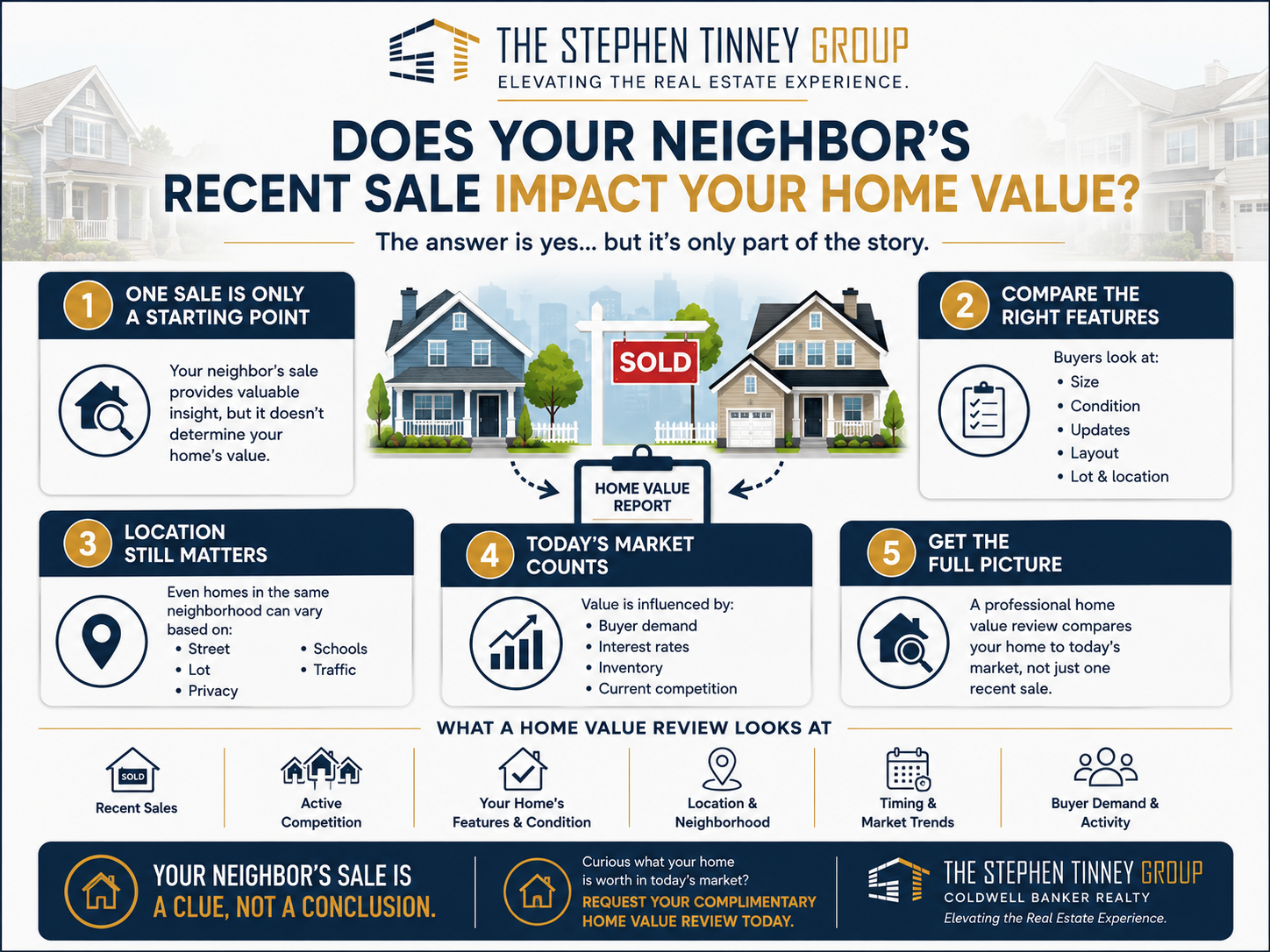
Your neighbor's sale is a clue, not a conclusion.
It's an excellent starting point, but it doesn't tell the whole story.
Every home is unique. Every buyer has different priorities. Every market changes over time. Whether you live in Fair Lawn, NJ, the Radburn section of Fair Lawn, Ridgewood, NJ, or another community in Bergen County, your home's value is influenced by much more than one recent sale.
Don't make major financial decisions based on one sale, an online estimate, or something you heard around the neighborhood.
Whether you're thinking about selling next month, next year, or you're simply curious about your home's equity, you deserve accurate information.
A home value review isn't a sales presentation. It's a conversation.
We'll review recent neighborhood sales, compare your home to today's market, discuss what makes your property unique, and talk through your options. If now isn't the right time to move, that's perfectly fine. At least you'll have the information you need when the time does come.
My goal has always been to help families make confident decisions, whether they're buying, selling, or simply planning for the future.
If you've been wondering what your neighbor's home sold for, or what that sale might mean for your own home's value, I'd be happy to walk through it with you. There's no obligation, just an honest conversation and a clear understanding of where you stand in today's market.